Labs 9 and 10: Vertebrate Skeletal Muscle
week 9
week 10
labs
muscle
in situ
force
stretch
recruitment
twitch
tetanus
temperature
The physiology of in situ vertebrate muscle
Before Lab
The first week will be a group lab on toad muscle. You should develop a hypothesis that you will test the following week for your independent lab.
Prepare for lab by:
- Read the lab manual for this weekʻs experiment [Lab 9/10]
- Outline the [Prelab] in your lab notebook. Summarize the important points for this experiment.
- Draft hypotheses for each experiment
- Time permitting, outline (write a topic setence and bullet point any supporting points that come to mind):
- Umbrella idea
- Mechanism 1
- Mechanism 2
- …
- end with a paragraph of your hypotheses
- For the methods, outline:
- subjects
- equiptment
- experimental treatments (be sure to note what variables are changing) and controls or comparisons
- analysis
- Do Quiz on Laulima (open 24 hrs before lab) for lab 9. No quiz for lab 10.
- Please bring a laptop with you to lab, if possible, to analyze your experimental results.
- Draft hypotheses for your independent lab (next week Lab 10). Get approval from your TA during lab 9.
- For lab 10, you will help your group members collect their data, but you will design, execute, and write up your own independent lab report.
Donʻt get confused!
- EMGs measure muscle electrical activity
- Donʻt confuse depolarization with FORCE DEVELOPMENT
- Explain in your intro how force is developed by the binding of actin with myosin (via crossbridge formation)
- [Helpful slides]
In Lab:
- Lab 9 manual [pdf] . Record data in your lab notebook.
- You should have plenty of time to complete the data collection and your figures during lab.
- This will be a Group Lab. Begin planning with your partners as you work.
- Start an outline with your lab partners and start outlining your discussion points, and the rest of the report. Use your time wisely to brainstorm as you work.
- Get your hypothesis for your independent lab approved by your TA prior to leaving.
After Lab:
- Group lab report due next week. See the guidance at the end of the manual [pdf]
- Always follow the content guidelines: [grading guidelines] [old style]
- It is a good idea to divide up the work of writing the lab by experiment. That way, each person writes a portion of the intro, methods, results, and discussion for their hypothesis.
- Work out your timeline with your lab partners during lab (and plan a face-to-face meet up so that everyone has a chance to comment and edit before the lab is submitted.
Next Week: Independent labs!
- You will help each other collect the data, but your hypothesis, analysis, and report will be your own.
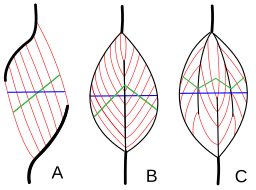
- For those of you wishing to look at muscle architecture, it is a good idea to compute the Physiological Cross-Sectional Area (the CSA through the perpendicular direction through the muscle fibers). To do so, take the mass of the dissected muscle (use the analytical balance upstairs, ask your TA), and bisect the muscle to look at the pennation angle of the fibers. Take a clear photo of your bisected muscle next to a ruler to measure fiber length (average) and pennation angle.
- You can calculate Physiological Cross Sectional Area as:
\[ PCSA = \frac{\text{muscle volume}}{\text{fiber length}} = \frac{\text{muscle mass}}{\rho\cdot \text{fiber length}} \]
Where \(\rho\) is the density of the muscle and is 1.06 g/ml.